





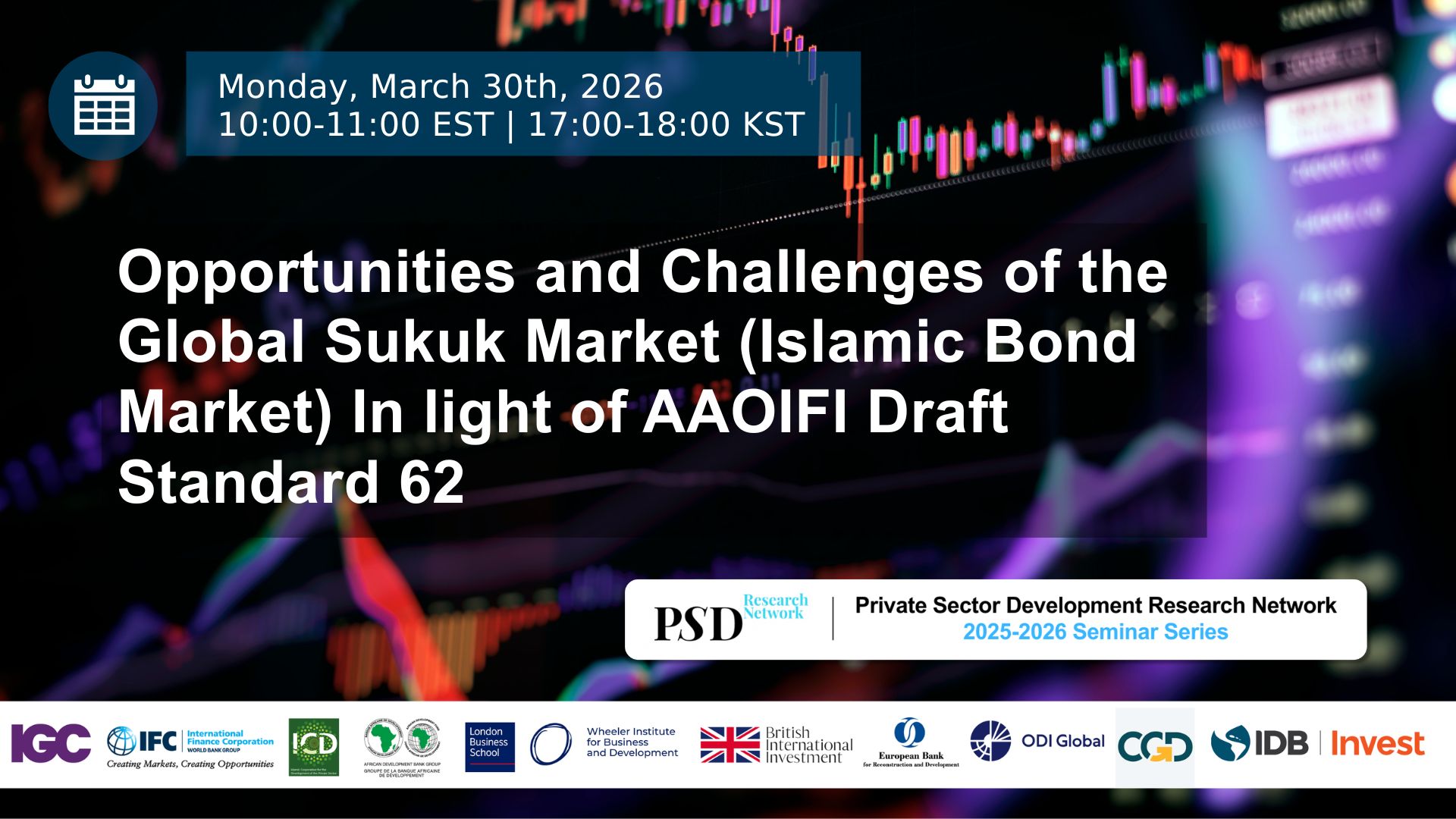
Opportunities and Challenges of the Global Sukuk Market (Islamic Bond Market) In light of AAOIFI Draft Standard 62
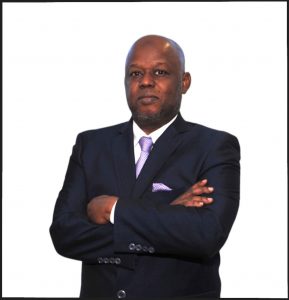
Presented by Muhammad Al-Bashir Muhammad Al-Amine
Islamic Corporation for the Development of the Private Sector
Moderated by: Elvin Afandi
Monday, March 30th, 2026 from 9-10am EST/16:00-17:00 KSA
Click here to register for the event
ABOUT THE SEMINAR
With global outstanding Sukuk issuance surpassing $1 trillion USD in the first half of 2025, the Sukuk market has emerged as a vital alternative financing tool for several countries across emerging markets in the Middle East, Asia, Africa and beyond. A key enabler of this growth is the existence of a unified Shariah compliance framework by The Accounting and Auding Organization of Islamic financial institutions (AAOIFI), which helped reduce ambiguity and led to consistency in Sukuk structures across countries. This standardization has facilitated cross-border issuance and investment, supported Sukuk inclusion in global indices, and attracted growing investor interest—including from non-Muslim investors. The Standard Setter is about to issue a revised Sukuk standard to provide more details and shedding light on imperative matters that enable Sukuk market to adhere more to its Islamic finance core principles. Although there are those who support the new changes, there are some stakeholders who believe that if the draft standard is accepted, adopted and implemented as is, there won’t only be a disruption, there will be an actual revolution in the sukuk market
The seminar will address the market concerns about the AAOIFI standard 62 on Sukuk and the debate between the proponents and opponents of the draft standard. The advocates of the standards argue that the standard is a vital course correction, turning sukuk back to its foundational principles. The challengers, on the other hand, argue that if the draft standard is adopted and implemented as it is, there would be disruption and possibly a revolution in the sukuk market. The session will highlight some of the controversial issues in the draft standard and how they could be mitigated. These issues include among others the real transfer of the underlying assets ownership to investors, moving Sukuk assets off balance sheets of the originators and possible increased cost of issuing Sukuk due to asset registration. Moreover, we have the possibility of asset confiscation and nationalization and market fragmentation between AAOIFI adopters and non-adopters. Besides these controversial issues in the draft standard, we have the challenge of the nonexistence of a modern legal framework dealing with issues such as the non-existence of securitization and asset backed Sukuk law, trust law, secured transactions mechanisms or favorable tax legislations in order to create a level playing field. Yet, it is believed that despite all these challenges a careful revision of the standard and the incorporation of practical suggestions from the industry and more importantly a close collaboration from all stakeholders including Shariah scholars, practitioners, lawyers and rating agencies meaningful solutions that will mitigate most of these concerns can be sorted out.
Muhammad Al-Bashir Muhammad Al-Amine
Advisor to the CEO on Shariah Matters, CEO Executive Office, ICD
Dr. Al-Bashir is currently an advisor to ICD’s CEO on Shariah matters. He was formerly the Group Head of Shariah Compliance of Alkhair Holding (formerly known as Bank Alkhair BSC). Prior to joining Alkhair Holding in 2005, Al-Bashir was the Head of Product Development and Shariah Compliance at the International Islamic Financial Market (IIFM). He was also a part-time lecturer at IE University, Spain, the Faculty of Laws International Islamic University Malaysia; Ibn Sina Institute of Technology (Malaysia); the Matriculation Center International Islamic University (Malaysia), the Bahrain Institute of Banking and Finance; the Kingdom University (Bahrain); and The Open University of Malaysia in Bahrain.
Dr. Al-Bashir is the author of Sukuk and Islamic Securitization Markets: Financial Engineering and Product Development (Brill,2012); Risk Management in Islamic Finance: An Islamic Analysis of Derivatives Instruments in Commodity Markets (Brill, 2008), Istisna (Manufacturing Contract) in Islamic Banking and Finance Law and Practice (A.S. Noordeen, 2001 & 2006) and Islamic Finance and Africa’s Economic Resurgence: Promoting Diverse and Localized Investment (Palgrave Macmillan, 2016). He has also contributed a number of articles published in international journals.