



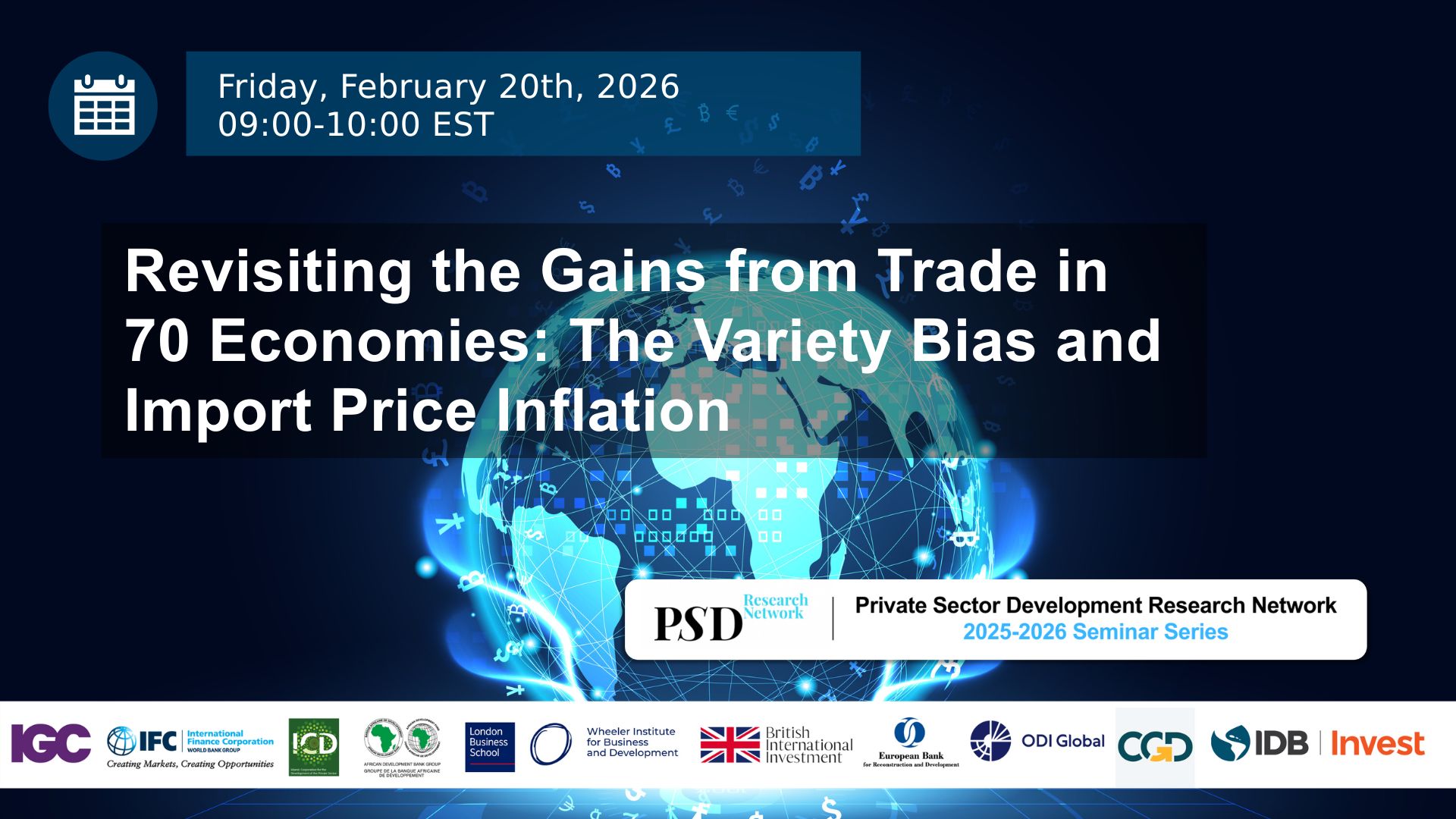
Revisiting the Gains from Trade in 70 Economies: The Variety Bias and Import Price Inflation

Presented by Angela Montfaucon
World Bank
World Bank
Organized by the Private Sector Development Research Network
hosted by the International Finance Corporation (IFC)
Friday, 20th February 2025 from 9-10am EST
Click here to join virtually the day of the seminar
ABOUT THE SEMINAR
We provide a comprehensive assessment of the welfare gains derived from import variety growth across 70 countries, accounting for approximately 70 percent of global imports. Following the Feenstra-Broda framework, we compute over 320,000 elasticities of substitution at the HS-6 level, allowing for the construction of an exact price index that accounts for entry/exit of varieties and enables cross-regional comparisons. Across the full sample, annualized gains from newly imported varieties average 0.15 percent of GDP per year, with marked heterogeneity: while the EU-15 Core shows negligible gains due to high baseline integration, the Post-Soviet and South-East African cohorts experienced variety increases exceeding 140 percent, yielding annualized welfare gains of 0.46 percent and 0.20 percent of GDP, respectively. Crucially, a macro-critical finding is that traditional price indices overstate import inflation by 1.1 percent annually in East Africa and 0.94 percent in Post-Soviet nations—compared to 0.21 in Western Balkans, 0.4 percent in East Asia and Pacific and only 0.04 percent in integrated European markets. This “variety bias” suggests that failing to account for new varieties leads to an upward bias in conventional import price indices that is especially salient in transitioning economies. The findings underscore that expanding trade linkages remains a primary welfare driver, especially for small and transitioning economies.
ABOUT THE SPEAKER
Angella Montfaucon (World Bank)
Angella Montfaucon is the World Bank’s Senior Economist in the Europe and Central Asia (ECA) Region, based in Tirana. In Albania, she leads dialogue on macro fiscal and trade policy and growth, flagship economic reports, budget support policy financing, and provides thought leadership on economic development by integrating structural, sectoral, climate, and macroeconomic perspectives. For the Western Balkans, she leads the Regular Economic Update and regional analytical work on trade policy and competitiveness. Previously, she worked in the Bank’s East Asia and Pacific Region based in Jakarta, covering Indonesia and Fiji, serving as Country Economist for Vanuatu, and contributing to analytical work and operations in the Philippines. Angella joined the World Bank as a Young Professional in 2019, after working on fiscal operations at the Reserve Bank of Malawi. She has over 10 years of experience, has published in leading economics journals, and holds a Ph.D. in Economics from Yokohama National University, Japan